- Scaling Agencies with Profit
- Posts
- Stop solving their problems
Stop solving their problems
You're slowing their development

Nick Avaria
January 29, 2026
Let me describe a scene that happens in every agency, probably multiple times a day.
An employee comes to you with a problem. They explain the situation - what went wrong, what the client said, what they're stuck on. They look at you expectantly, waiting for you to tell them what to do.
And you do. Because it's faster. Because you know the answer. Because there's a deadline and you don't have time for this to be a teaching moment.
You solve the problem. They go execute your solution. The immediate issue gets handled.
But something else happens too, something you don't notice in the moment: you've just taught them that when things get hard, the answer is to come to you. You've reinforced a pattern where they're the executor and you're the thinker. You've made yourself more essential, not less.
This is how agency owners end up trapped.
Your team is not incapable, but they've never been taught to be capable.
Every solved problem is a missed opportunity for development.
Every quick answer is a lesson in dependency.
If you want to scale - and I mean really scale, to the point where the business runs without you in every decision - you have to change this pattern.
I have acquired & sold 7 agencies.
This is what I do instead when someone comes to me with a problem.
First, I make them articulate the problem.
Not just describe the situation - identify what they're trying to solve. This sounds simple, but it's where most people fall apart. They can tell you what happened. They can tell you what the client said. But they can't clearly state what the actual problem is.
So I ask questions.
What are you trying to solve here? What's the real issue underneath the surface? If they're too far off, I give them clues. I point them in a direction. But I never give them the answer. They need to learn how to identify problems correctly before they can solve them - and that's a skill that only develops through practice.
Second, I make them come up with solutions.
Not one solution. Multiple approaches. I don't let them dump problems on my desk and wait for me to hand back answers. That's not how thinking develops.
When you force someone to generate options, you're building their strategic capacity. They start to see that most problems have several possible paths forward. They start weighing tradeoffs. They start thinking about second-order effects. They stop being task executors and start being problem solvers.
Third, I act as quality assurance - not the task doer.
My role is reviewing their thinking and helping them refine it.
I'm checking their work at the end, not doing it for them in the middle. I might push back on their reasoning. I might ask questions that expose gaps they hadn't considered. I might suggest they think about an angle they missed.
But the thinking is theirs. The solution is theirs. They own it.
This is harder than just solving problems yourself.
It takes more time in the moment. It requires patience when you're stressed and deadlines are looming.
But when you do this:
You're teaching them how to do new things they've never done before.
How to approach unfamiliar situations with a framework instead of panic.
You're teaching them that they're capable of solving problems without your help.
That they have the intelligence and judgment to figure things out - they just need to use it.
You're teaching them that failure is a possibility, and that's okay. That trying something and getting it wrong is part of learning. That you're not going to punish them for imperfect solutions - you're going to help them learn from them.
This is how you progressively get less work handed to you as you scale.
Not by hiring better people - though that helps - but by developing the people you have into thinkers instead of executors.
One more thing.
I put together a resource on building the operational systems that let you scale to eight figures.
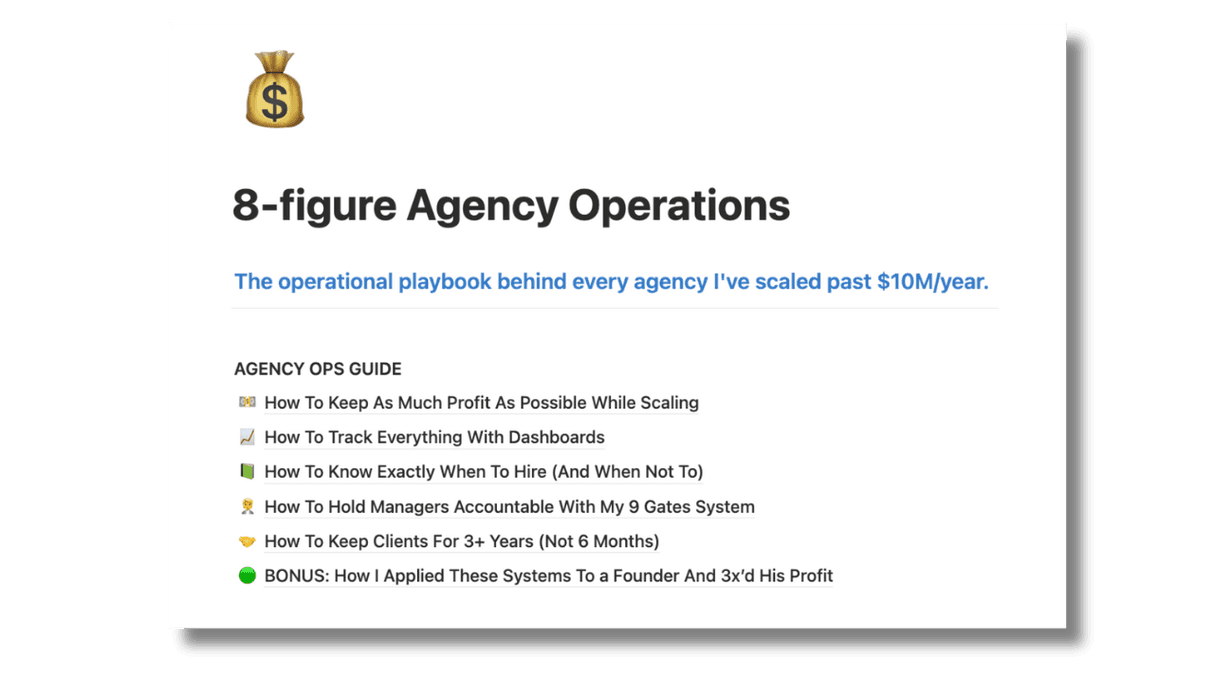
It covers a lot of what I've been sharing in these emails - the dashboards, the accountability structures, the management frameworks.
I want to make sure everyone on this list has access to it:
Nick
P.S.
Quick note:
I keep a few hours open each week for agency owners who want a second set of eyes on their operations.
Book a call here if that's useful: https://www.agencyacquisitions.io/book-a-call/
